Bringing a popular in-store financing option online, creating a seamless and secure installment experience for customers.

Industry:
Led the design of the digital checkout journey for Boleto Parcelado
Defined UX strategy, flow architecture, and micro-interactions
Created interface and contextual communication for transparency and clarity
Integrated design with the Credit Marketplace backend
Planned and oversaw the email and alert flows for status, success, error, and cancellation
Challenge
Bringing "Boleto Parcelado" online seemed simple at first, but it revealed a challenge of architecture, UX, and integration.
Unlike physical stores, CVC’s online checkout does not follow a step-based model — everything happens on a single page. This created key limitations:
Lack of separation between payment and confirmation stages, complicating new flow inclusion.
Dependence on automatic validations and external communications with the credit marketplace without intermediate user feedback.
Backend constraints preventing redirections between screens without data loss.
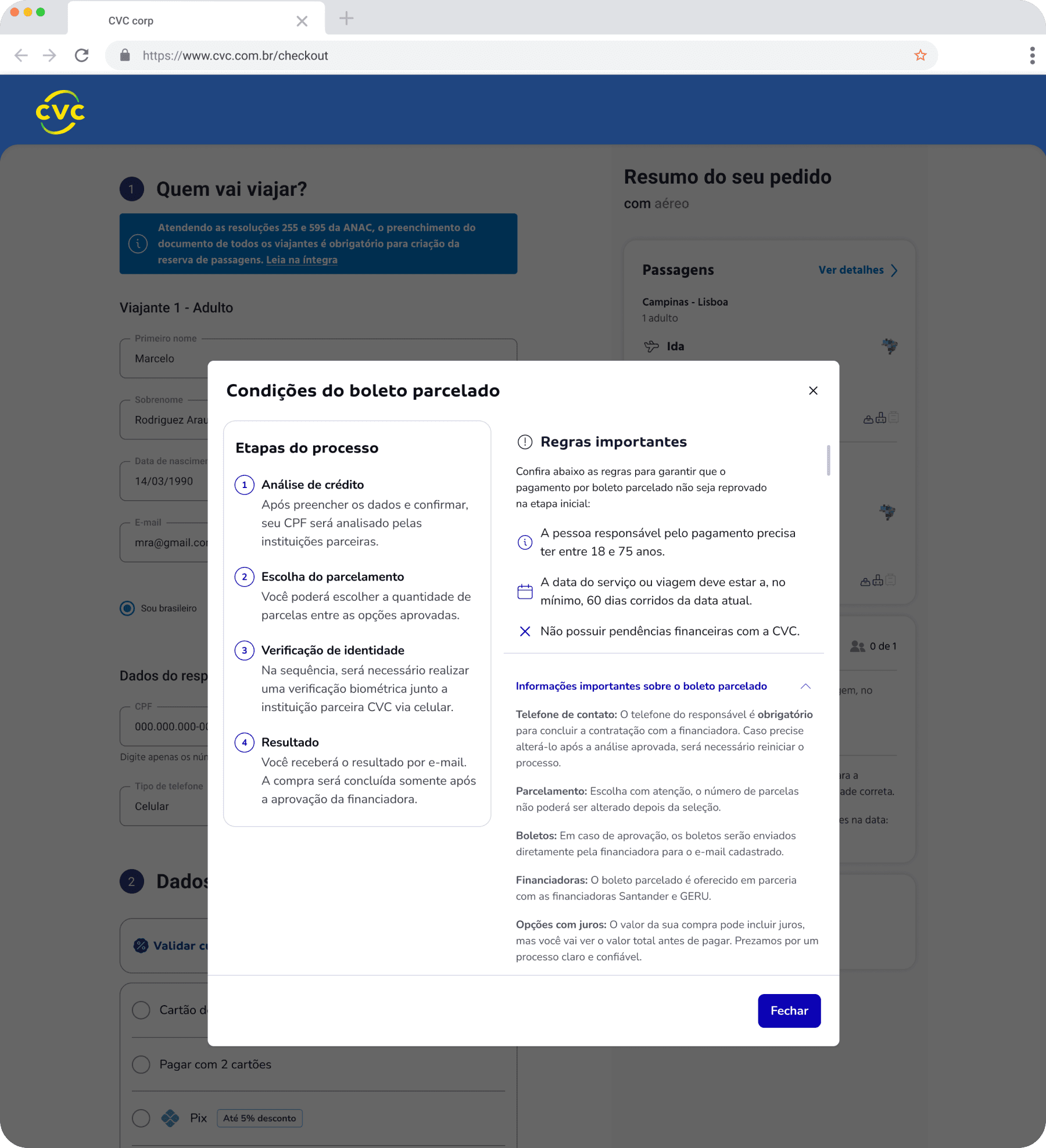
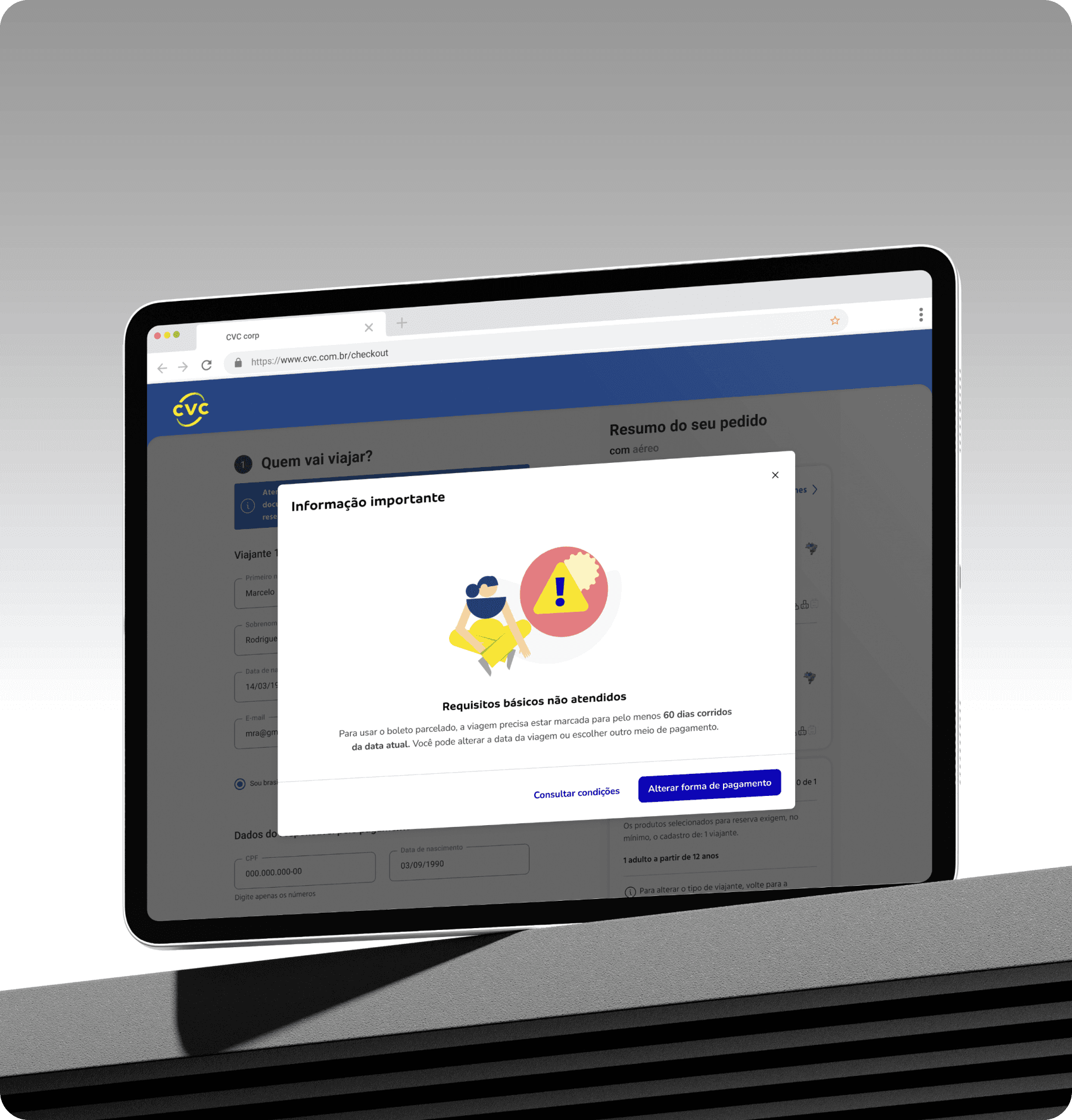
Additionally, the eligibility rules — such as customer age, minimum travel date, and internal credit history — could interrupt the flow, requiring clear, empathetic, and contextual messages to prevent frustration.
Another critical point was that the identity verification step occurs outside CVC, within the partner financial system. The challenge was to preserve the continuity of the experience, even across different platforms.
Solution
To overcome these challenges, our approach focused on three pillars: clarity, trust, and continuity.
Clarity
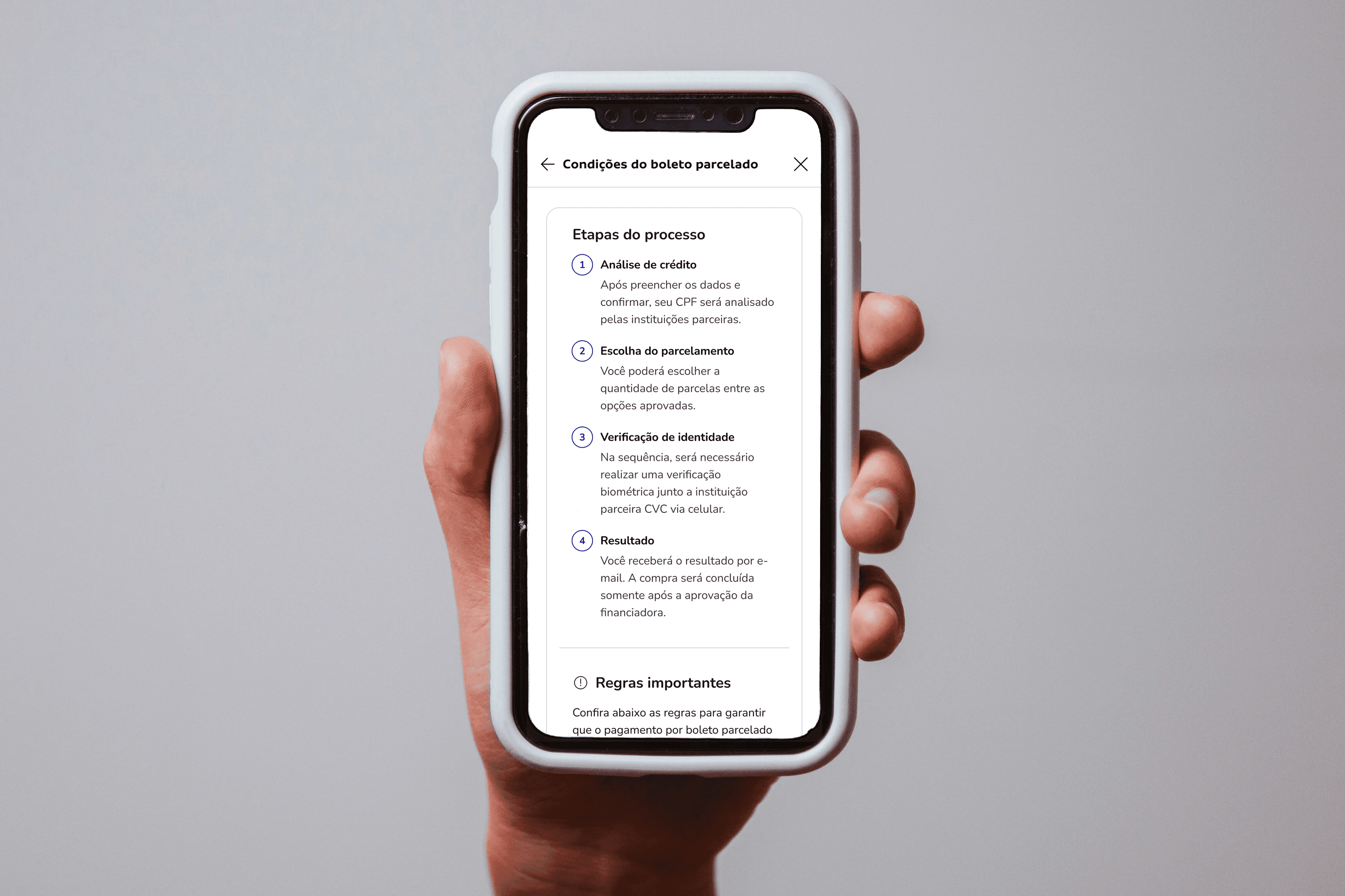
Simplified interface explaining the Boleto Parcelado flow.
Tooltips for CET, fees, and IOF ensure transparency and legal compliance.
An explanatory modal details conditions and steps before the customer starts the process.
Trust
Guidance and microcopy support sensitive data entry and identity verification with the financial partner.
Mandatory fields like “Mother’s full name” are clearly highlighted.
Preventive alerts explain irreversible consequences, such as proposal cancellation when navigating back.
Continuity
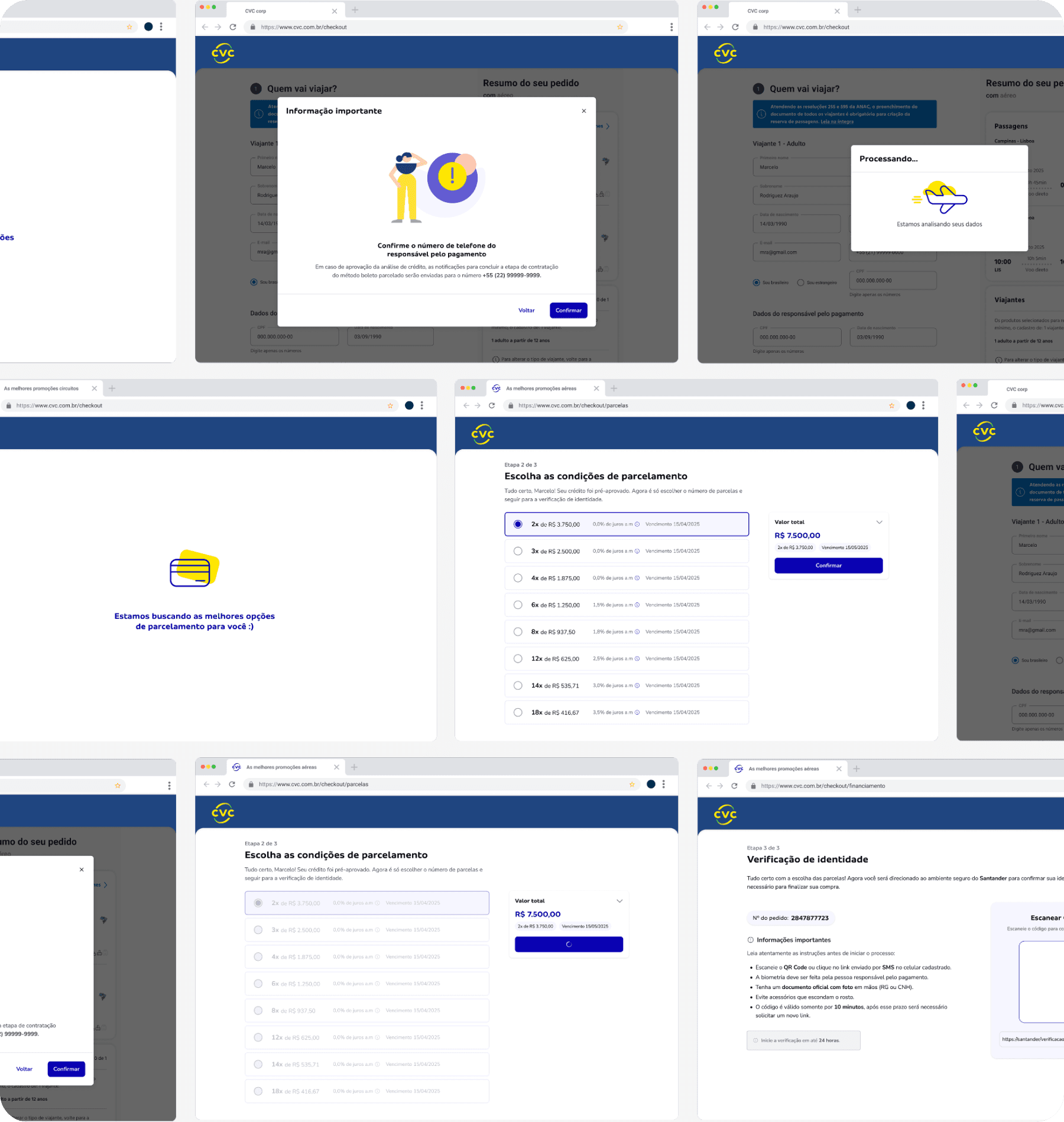
Even without native steps, we simulated mini-stages on the same screen, with immediate visual feedback.
Customers clearly see credit approval, available installment options, and next steps.
Status messages and alerts prepare users for the identity verification stage with the partner.
Integration with the Credit Marketplace
Reused the existing backend from physical stores, connecting the online checkout to partner financial institutions.
The marketplace automatically queries institutions, returns installment and rate options, and delivers proposals ready for confirmation.
This allowed replicating the same service level as physical stores in a digital environment.
The result is an intuitive and secure flow, turning a complex process into a clear, continuous, and reliable experience for customers, even given system limitations.
Impact
The Boleto Parcelado implementation will deliver significant results for both user experience and business outcomes.
Financial and Conversion Impact
The project will open access to customers without credit cards or sufficient limits, increasing online conversion rates.
The modality will become a new revenue stream, generating sales that previously could not be completed online.
Although working with the existing Marketplace infrastructure brought additional complexity, it also enabled a major advantage: we can launch and test this new payment method with significantly lower integration costs, since we’re leveraging the backend already used by physical stores.
User Experience
Simulated mini-stages will provide clarity and sense of progress, reducing doubts and abandonment.
Transparency around rates and installments, combined with microcopy guidance, will increase customer trust.
Email communication, including reminders, confirmations, and cancellation alerts, will reinforce a secure and continuous experience.
Post-Launch Strategy & Metrics
To ensure that the new Installment Boleto Payment evolves sustainably after launch, I defined a post-release strategy focused on data, performance, and continuous optimization. An approach that is still emerging at CVC but essential for validating hypotheses and improving conversion.
1. Key KPIs
We established three core areas of measurement:
Adoption: percentage of eligible customers who choose the installment option.
Conversion: progression through each step of the funnel (checkout → offer → verification → completion).
Performance: load times and technical errors that may impact finalization.
These indicators will help identify bottlenecks and guide iterative improvements.
2. Proposed Instrumentation
To support data-driven decision-making, I outlined a minimum instrumentation plan for both web and mobile:
Event tracking for each funnel step
Error tracking segmented by lender (Santander / Geru)
Abandonment events (back navigation, modal closure, verification exit)
Average time spent on each screen
Interaction tracking with tooltips, QR codes, buttons, and microcopy
Parameters sent to analytics to differentiate lenders and selected plans
This structure provides full visibility into real user behavior.
3. Initial CRO Roadmap
To ensure continuous evolution after launch, I mapped hypotheses and experiments:
Financial clarity: A/B testing of CET/interest explanations
Friction in mandatory fields: alternate labels and tooltips for the “Mother’s full name” input
Understanding the approval flow: testing microcopy variations around next steps and boleto availability
These experiments aim to improve conversion, reduce friction, and optimize the overall performance of the payment flow.
The work presented here features only a segment of the project, aimed at protecting sensitive information belonging to the client or the company being showcased.